

Retention, growth, profit, and a product AI can’t easily replace all shape a SaaS company’s price. Each can be strengthened before buyers start asking.
Picture a founder in Plano. Her software company brings in about $14 million a year in subscription revenue, turns a profit, and grows steadily. She plans to sell within three years. Then the 2026 headlines arrive: software valuations have crashed, and AI is to blame. She wonders how much of her company's value just disappeared.
Probably far less than she fears. The SaaS valuation crash of 2026 happened mostly to companies that weren't for sale. Over the year to mid-2026, what investors paid per dollar of revenue at listed SaaS companies fell by more than 40%, according to Software Equity Group (SEG). Private SaaS companies kept selling for about four dollars per dollar of revenue.
For a founder selling a SaaS company in the middle market, that gap changes the question. Buyers are still writing checks; they just want more proof first. At Lighthouse Value Partners, the question we hear from SaaS founders is direct: what does a buyer need to see before paying full price?
The public selloff started with a pricing worry. Many SaaS companies charge per user, or per seat. If AI agents can do work that once needed ten people logged in, a customer might need only two or three licenses.
Private buyers run on a different clock. They're buying a company to own for years, so a few weeks of sentiment counts for less than how the business performs. SEG's tracking shows SaaS deal activity at its highest recorded level, with private equity involved in more than half of all deals.
The SaaS M&A market trends of 2026 still point toward selectivity. SEG's latest quarterly SaaS report describes buyers setting a higher bar for strategic fit, AI relevance, how deeply a product is woven into customers' daily work, and long-term defensibility. Our Plano founder will find buyers. They'll bring harder questions.
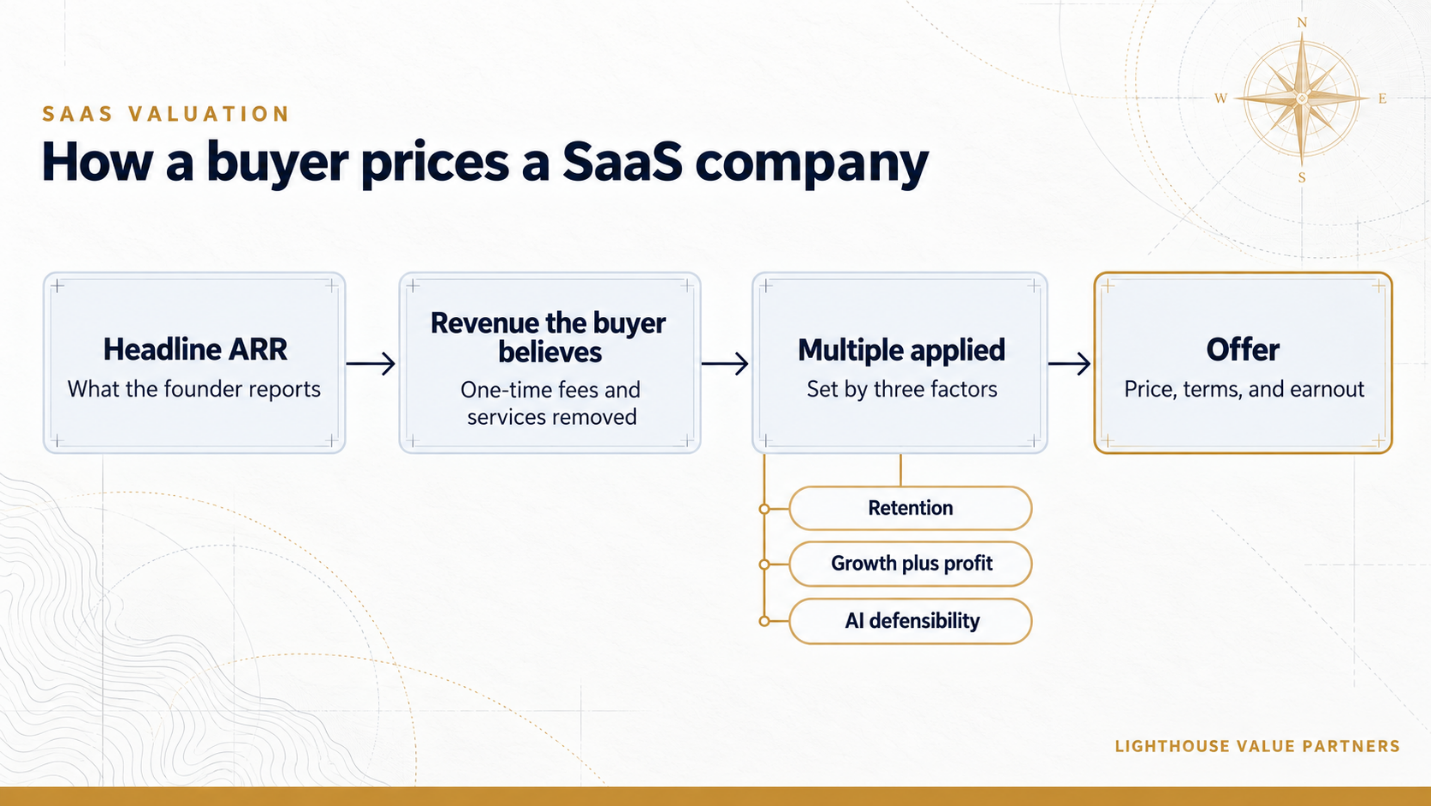
Most SaaS companies are priced as a multiple of annual recurring revenue (ARR), the subscription income a company expects to collect over the next year. At about four times ARR, our founder's business would be worth roughly $56 million. Whether she lands above or below that depends on how much a buyer trusts the revenue.
Profitable companies get a second look. Buyers, private equity firms especially, also apply SaaS EBITDA multiples, which value the business on its earnings. Earnings that hold up to that scrutiny depend on financial leadership before a sale.
Before any multiple applies, the buyer sorts the revenue. Setup fees, consulting work, and brand-new contracts get set apart from subscriptions that have renewed for years, and the buyer's team rebuilds ARR from billing records to confirm it holds.
Customer concentration risk adds to the discount. If one customer pays more than roughly 15% to 20% of a company's ARR, buyers often lower the price or hold part of it back until that customer renews. SaaS M&A due diligence tests that exposure alongside contracts, IP ownership, and security, the same pressure points behind deals that unravel after the LOI.
Yes. Net revenue retention (NRR) answers a simple question: if you stopped signing new customers tomorrow, would revenue from your existing ones still grow? Above 100%, it would, because upgrades outpace cancellations.
Gross revenue retention (GRR) ignores upgrades and measures how much revenue leaks out of the bucket each year. Buyers read the two together, since healthy expansion from a few large accounts can hide steady losses everywhere else.
SaaS Capital's 2026 survey puts median NRR at 103% for bootstrapped companies of our founder's size. In plain terms, the typical company in that group grows about 3% a year from existing customers alone.
The Rule of 40 adds revenue growth to profit margin, so growth and profit share a budget of 40 points. Our founder, growing 15% a year, needs a 25% profit margin to meet it. In an Aventis Advisors analysis of listed SaaS companies, those that cleared the bar traded at revenue multiples nearly 75% higher than those that fell short. Private buyers use the same screen.
In SEG's 2026 survey of SaaS buyers, more than eight in ten named AI-driven commoditization as the biggest risk to SaaS value. For a private company, the impact of AI on SaaS valuations comes down to one blunt diligence question: if AI makes software cheaper to build, what keeps your customers from replacing yours?
AI defensibility in SaaS comes from things a competitor can't copy over a weekend. Think of a dispatch platform a field-service team works in all day, connected to its accounting, payroll, and customer records. Replacing it means retraining staff, moving years of data, and rebuilding every connection. Proprietary data and industry know-how add to that cost.

When software runs a team’s daily work, such as scheduling and dispatch, replacing it means retraining staff and moving years of data. Buyers see that as defensibility.
Buyers also separate AI features from AI results. SEG reports they favor companies with measurable gains, such as stronger retention or better margins, over those still experimenting.
That distinction is showing up in actual acquisition decisions. When private equity firm GTCR agreed to acquire software provider CCC Intelligent Solutions in October 2026, principal Nelson Iginla told Reuters, “When you peel things back, it's a business that we think is made better by AI, not worse by AI.”
Waiting only pays if the multiple holds. If our founder keeps growing at 15% a year, her ARR reaches about $18.5 million in two years. If buyers then pay three times revenue instead of four, her company is worth about the same as it is today. Two years of hard-won growth, and the price barely moves.
A SaaS exit strategy that waits for markets to recover leaves the outcome to buyer sentiment. Preparing a SaaS company for sale puts the effort into the things that set the multiple.
As financial strategist Melissa Houston wrote in Forbes, buyers now ask, "How much of this success will transfer to a new owner?" For a SaaS founder, answering that question takes 12–24 months of deliberate preparation, including:

This is the work of an operating partner: an operator embedded in the business before a sale, improving what a buyer will eventually price. Across LVP engagements, the average increase in business value has exceeded 40%, and in roughly half of them the founder was able to step out of daily management.
Texas founders have an advantage in building the leadership team this requires. According to CompTIA's 2026 workforce report, Texas is projected to add more tech jobs this year than any other state, and Dallas ranks second among U.S. metros.
Are private SaaS valuations lower in 2026?
Slightly. Private SaaS acquisitions closed at a median 4.0x revenue in the second quarter of 2026, according to SEG, while listed SaaS companies fell to 3.2x. Strong retention and defensible products still command premiums.
What is a good net revenue retention rate for a private SaaS company?
Above 103% beats the SaaS Capital median for bootstrapped companies with $3 million to $20 million in ARR. Top performers reach about 118%. Companies selling to small businesses typically run lower.
Do buyers value a profitable SaaS company on ARR or EBITDA?
Usually both. Buyers start with an ARR multiple, then test it against EBITDA, private equity firms especially. Consistent, well-documented earnings help a founder defend the ARR-based price.
How long does it take to prepare a SaaS company for sale?
Typically 12 to 24 months. That builds a reporting history buyers trust and shows retention improving across several quarters.
Picture our Plano founder going to market as things stand. Nobody tracks retention. Two customers account for a third of revenue, and every major renewal runs through her phone. Buyers price that uncertainty in with a lower multiple, an earnout, or a quiet exit from the process.
Now picture her eighteen months later. Retention is reported monthly and ties to billing. No single customer carries an outsized share of revenue. Her leadership team owns renewals, and the AI roadmap shows up in margins. Same company, same headlines, and diligence becomes a matter of confirming the price.
If you're 12 to 36 months from selling a SaaS company and want to know which of these would move your multiple, our Business Optimization team is a good place to start.
Matt Shields
Partner, Lighthouse Value Partners
lighthousevaluepartners.com
Chris Percy
Partner, Lighthouse Value Partners
lighthousevaluepartners.com