
Why the founders who finish well stop asking “how much” and start asking “what now”
Ask most advisors what makes exit planning for founders so difficult and you’ll get the standard inventory: due diligence, the working capital adjustment, Key Man Insurance, the courtship between strategic buyers and institutional capital. All real. All necessary. And none of it is the actual problem.
A 2025 peer-reviewed study on succession in family firms, published in the journal Sustainability, found that the primary barrier to a successful transition isn’t financial at all. Founders see their business as a lifestyle and a legacy, often built across generations, rather than a financial asset. The handover only works when the founder reframes what their role will be after the business changes hands. The deal mechanics aren’t the bottleneck. The founder is.
I say that with affection, because I’ve been one. I’m a third-generation entrepreneur. I know exactly how it feels when someone suggests that the thing you built — the thing that fed your family and anchored your community — should now be examined like a line item.
The founders who finish well share a common trait: they treated the transaction as a beginning, not just an ending. Before the wire transfer cleared, they had already answered the harder question — what their post-exit life was actually for.
The cause is consistent across cases. They optimized for the close and left the harder assignment unfinished: deciding, before the wire transfer cleared, what their post-exit life was actually for. A transaction that maximizes enterprise value while leaving that question unanswered is not a complete success. It is a beginning that got mistaken for an ending.
The same pattern shows up earlier in the process. Roughly 68% of business owners have spent minimal time on a written exit strategy, even though nearly half want to transition within five years. That is hardly laziness. You cannot plan a transition you have not yet emotionally accepted. The unwritten plan is an identity question wearing a planning failure’s clothes.
And the stakes are enormous. Family-owned businesses generate 54% of U.S. GDP and employ 83.3 million Americans. An estimated $84 trillion in wealth will transfer by 2045, half of it locked inside privately held businesses. Whether founders capture their share depends almost entirely on what they do before going to market. The math is not subtle.
Every founder I’ve worked with has redefined success several times without noticing. First it meant survival. Then growth. Then profitability, then the right people, then a reputation worth protecting. Each of those company maturity stages quietly rewrote the goal, and the founder adapted every time.
Then comes the stage nobody warns you about: scaling to exit. For the first time, the goal is a business that no longer needs you, the kind of organizational maturity a buyer will pay a premium for. And here is where the word “change” does real damage. Tell a founder they need to change their strategy, change their model, change how they operate, and you’ve implied that what they built was wrong.
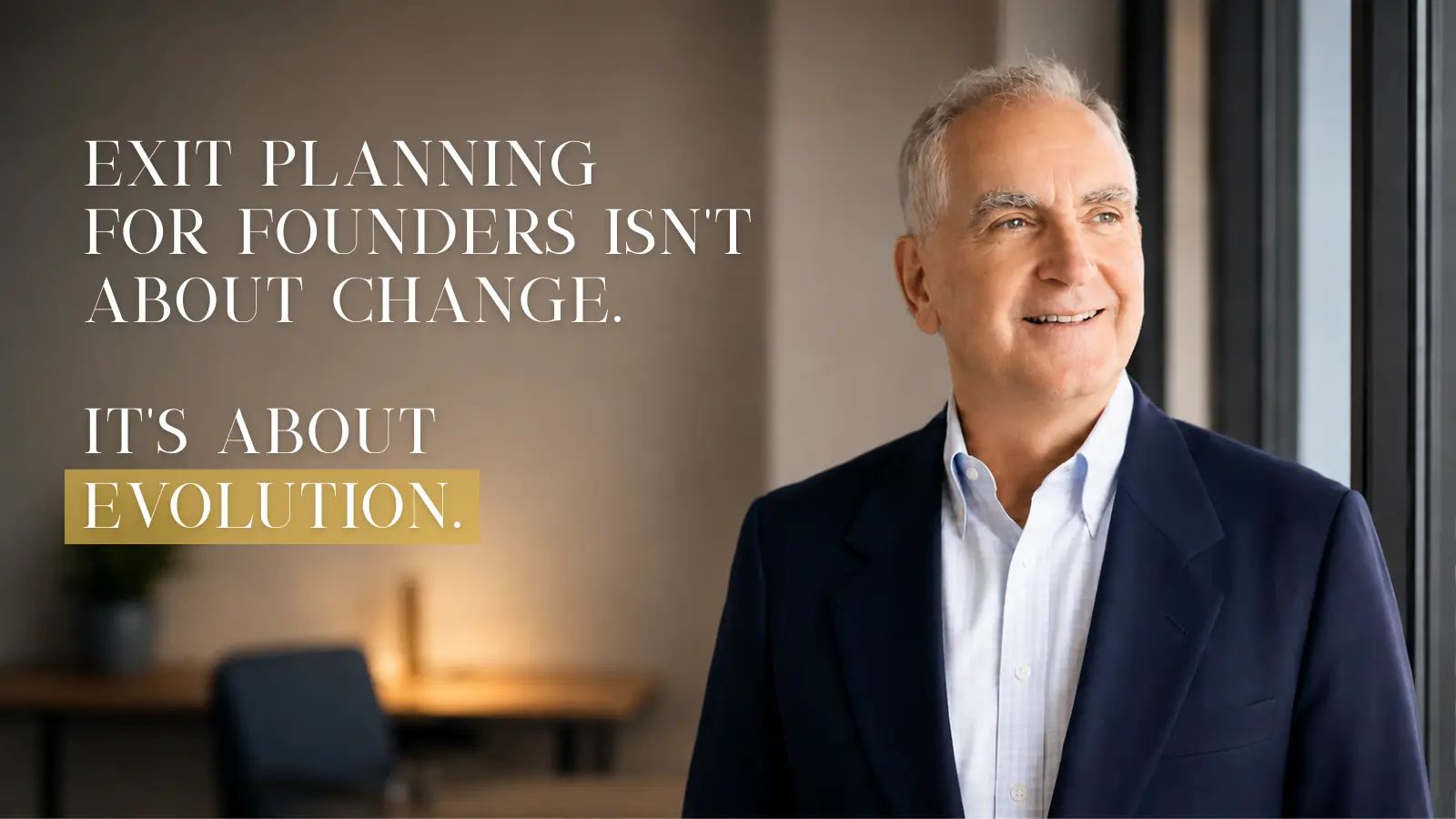
It wasn’t. It was exactly right for the chapter it belonged to. The founders who finish well don’t change. They evolve. Same drive, same values, same fierce instinct to protect their family and their people. Only the method moves.
Bo Burlingham made this point in Finish Big, still the best book written on the identity side of an exit: “Until you’ve moved on — not just physically but psychologically — to a new venture, a new career, a redefined role, or even retirement, your exit isn’t complete.” I made a related argument in Wealth That Lasts: a business legacy is built on values, not just valuables. Put the two together and the conclusion is uncomfortable but useful. The transaction is the easy part. The evolution is the work.
68% of owners have no written exit strategy. That's not a planning failure, but an identity question they haven't resolved yet.
Picture a founder — call him Frank — 64 years old, three decades into a manufacturing company, now contemplating a mid-market business exit. Frank has made plenty of money. Money is not his question. His questions are: Will the brand survive? Will the people who built this with me be protected? Will the company keep growing after I release control?
Now watch what happens when Frank takes those questions to a commission-driven intermediary. He gets a valuation, a timeline, and a pitch deck. Nobody is paid to answer what Frank actually asked. The broker’s incentive ends at the closing table; Frank’s questions begin there. Show me the incentive and I’ll show you the outcome. Three times out of four, the outcome is a founder with a full bank account and an empty calendar, wondering what just happened.
What Frank needs is a different sequence: define what success means now, then build the founder exit strategy backward from that definition, whether the next owner is a family member in a family business succession, a strategic acquirer, or a growth capital partner.
The exit planning profession knows this, at least officially. The Exit Planning Institute teaches that readiness is personal and financial before it is operational. Most of the industry nods at that idea and then skips straight to the spreadsheet.
We built our process to make skipping it impossible. Every Lighthouse Value Partners engagement begins with a Founder’s Survey: a confidential conversation about what the founder actually wants, for themselves, their family, their people, and their next chapter. No spreadsheets involved.
What comes out of it is the definition of success that every later decision, from business succession planning to wealth management for founders, has to serve. A transaction that maximizes enterprise value while ignoring the founder’s personal objectives is not a success. It’s just a closing.
So if you’re a founder weighing a founder-led exit in the next few years, skip the multiple for now. Start with the harder question, the one your evolution has been preparing you to answer all along.
Founders, what is your opportunity for success?
If you’re a founder thinking about life after selling a business — what it should look like for you, your family, and your legacy — the Founder’s Survey is where that conversation begins. It costs you one honest conversation. Most founders already know what they’d say. They just haven’t said it out loud yet.
Founding Partner, Lighthouse Value Partners
Author, Wealth That Lasts (USA Today & Wall Street Journal Bestseller)
lighthousevaluepartners.com